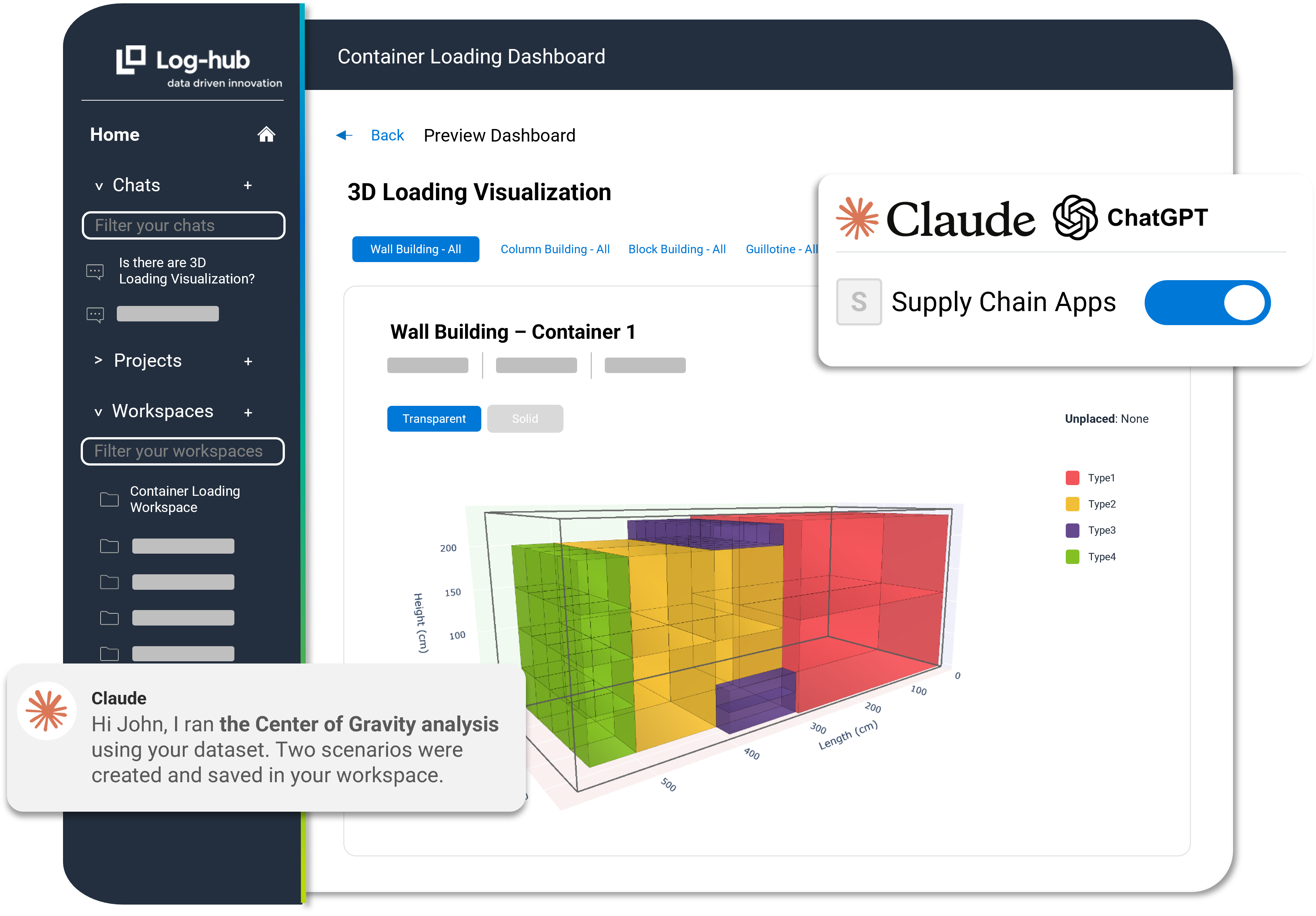
AI integration, 3D container loading, and enhanced optimization help supply chain teams make faster, more informed planning decisions.
SCHINDELLEGI, SWITZERLAND, August 5, 2026 /EINPresswire.com/ — Log-hub’s latest Supply Chain Apps update release brings advanced supply chain analysis closer to everyday planning, combining direct access through Claude and ChatGPT with a new 3D Container Loading Optimization application and more realistic freight and network modelling.
Supply Chain Apps Connect with Claude and ChatGPT
Users can now connect Supply Chain Apps directly with Claude or ChatGPT using their Supply Chain Apps API key, with only a free Claude or ChatGPT account required.
From the AI environment they already use, teams can combine external and internal data with Supply Chain Apps analyses, validate previous results, compare scenarios, and create dashboards, maps, and presentation-ready outputs. Results can then be saved to a Log-hub workspace for further analysis and collaboration.
Alexander Sigmund, CTO of Log-hub, comments: “The real opportunity with AI in supply chain is not simply getting faster answers. It is giving AI access to the right analytical capabilities so those answers can support real decisions. This release is an important step in that direction.”
3D Container Loading Reflects Real Loading Conditions
The new 3D Container Loading App extends traditional two-dimensional packing into a three-dimensional loading environment, helping teams plan shipments closer to how they are loaded in real life. Alongside package dimensions and quantities, it considers practical restrictions such as orientation, stacking, weight limits, container capacity, and product compatibility.
The app automates container planning by evaluating different loading approaches to determine how goods should be distributed across available containers while respecting operational constraints such as weight limits, stackability, rotation rules, and separation requirements. By maximizing container utilization and reducing the number of containers required, it helps planners create feasible loading scenarios with less manual effort. The result is an optimized loading plan and detailed shipment manifest that warehouse, and logistics teams can use directly to support efficient execution.
Improvements Across Supply Chain Apps
The release also introduces improvements across freight planning, network design, optimization, and platform administration. Freight Matrix Plus can now automatically assign freight zones and account for shipment-specific surcharges and discounts, helping teams build cost analyses that better reflect actual carrier agreements.
Improvements to the Admin Center simplify application access management across growing organizations, while redesigned Network Design dashboards make scenarios and key KPIs easier to explore. Shipment Flow Optimizer and Supply Chain Designer also introduce warehouse processing times and facility constraints, allowing teams to model networks that more closely reflect real operating conditions.
This release also includes continuous performance improvements powered by the new Hexaly solver, enabling faster calculations, higher-quality optimization results, and support for even larger datasets.
Together, these improvements reduce manual effort, bring analysis closer to operational reality, and make it easier for teams to move from planning to informed decision-making.
Milica Malinovic
Log-hub AG
email us here
Visit us on social media:
LinkedIn
YouTube
Legal Disclaimer:
EIN Presswire provides this news content “as is” without warranty of any kind. We do not accept any responsibility or liability
for the accuracy, content, images, videos, licenses, completeness, legality, or reliability of the information contained in this
article. If you have any complaints or copyright issues related to this article, kindly contact the author above.

Media gallery