Peru’s oil palm sector grew 49.9% in early 2026, led by Ucayali, as it displaces coca and employs over 22,000 people in the Amazon.
PUCALLPA, UCAYALI, PERU, July 13, 2026 /EINPresswire.com/ — According to a report by Infobae, oil palm led agricultural growth in Peru during the first two months of 2026, with a 49.9% increase compared to the same period the previous year, according to an official report from the Ministry of Agrarian Development and Irrigation (MIDAGRI).
The result far outpaced other crops with notable growth in the period — blueberries (21.2%), avocados (14.4%) and rice (11.8%) — and confirmed oil palm as one of the driving forces of the agricultural sector, which grew 2.4% overall between January and February.
The regions behind this performance are Ucayali, Huánuco and Loreto, where favorable weather conditions — driven by seasonal rains that allowed water to accumulate in reservoirs — supported crop development. In February alone, oil palm output grew 48.4% in Ucayali and Huánuco, according to the same report.
Oil Palm in the Amazon Economy
Unlike other crops, oil palm is harvested year-round, giving rural families a steady income instead of depending on seasonal cycles or volatile markets. The trees produce for approximately 35 years. In regions where flooding and overflowing rivers regularly disrupt economic activity, that stability carries particular value.
The Inter-American Development Bank has documented oil palm as one of the crops most heavily promoted by the Peruvian government, in part for its role as an economic alternative to coca leaf. Ucayali, historically marked by informal labor, illicit crops and limited opportunities, now accounts for most of the country’s oil palm expansion. The industry generates more than 2,000 direct formal jobs in the region and directly or indirectly benefits more than 22,000 people. The production chain includes approximately 140 smallholder farmers who contribute nearly 1,700 cultivated hectares, receive ongoing training in agricultural, environmental and legal practices, and operate under traceability and no-deforestation policies.
Forest Conservation and Native Communities
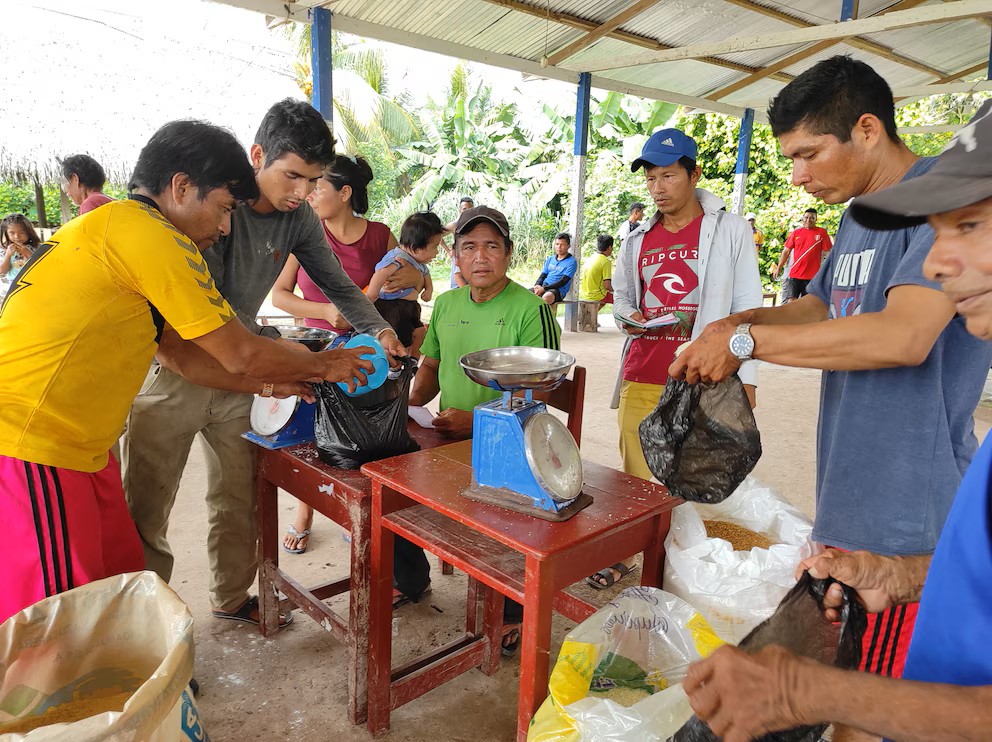
The expansion of oil palm in the Peruvian Amazon does not operate in isolation from its social and environmental surroundings. In Ucayali, conservation agreements signed with Shipibo-Konibo native communities — including Shambo Porvenir and Santa Clara de Uchunya — have placed more than 2,000 hectares of primary forest under protection for periods of 25 years. These agreements create economic incentives for communities to monitor their territories, prevent logging and preserve biodiversity.
Ocho Sur, the oil palm company with the largest presence in Ucayali — accounting for more than 50% of the region’s exports — and an accumulated investment of approximately USD 160 million since 2016, is one of the operators that has signed this type of alliance with local communities. Its markets include the United States, Europe and Latin America.
The model being replicated across the region combines a circular economy — reusing byproducts from the extraction process — with the formalization of production chains and conservation agreements that run in parallel with commercial activity.
Climate Context and Outlook
The rebound in oil palm production in early 2026 is explained in part by a moderate El Niño phenomenon that has not caused major disruptions to food supply. Intense seasonal rains have supported water accumulation in the country’s main reservoirs. MIDAGRI noted that the coastal El Niño phenomenon will persist in Peru through January 2027, with mostly weak intensity, though it could reach moderate levels between June and July 2026. The Multisectoral Commission responsible for the National El Niño Study reported that warm sea conditions will continue and that rainfall on the northern coast will remain within normal ranges.
The livestock subsector also contributed to first-bimester growth, with a 1.8% increase driven by pork (+3.8%), raw cow’s milk (+2.3%), cattle (+1.8%) and poultry (+2.0%) production. Still, it was agricultural performance — led by oil palm — that set the pace for the sector at the start of the year.
Ocho Sur and other operators in the oil palm industry maintain that economic growth and environmental responsibility can advance simultaneously in the Amazon, and that first-bimester indicators — production, employment, forest conservation — document that progress in a region long associated with informality.
Comunicaciones Ocho Sur
OCHO SUR
email us here
Legal Disclaimer:
EIN Presswire provides this news content “as is” without warranty of any kind. We do not accept any responsibility or liability
for the accuracy, content, images, videos, licenses, completeness, legality, or reliability of the information contained in this
article. If you have any complaints or copyright issues related to this article, kindly contact the author above.

Media gallery